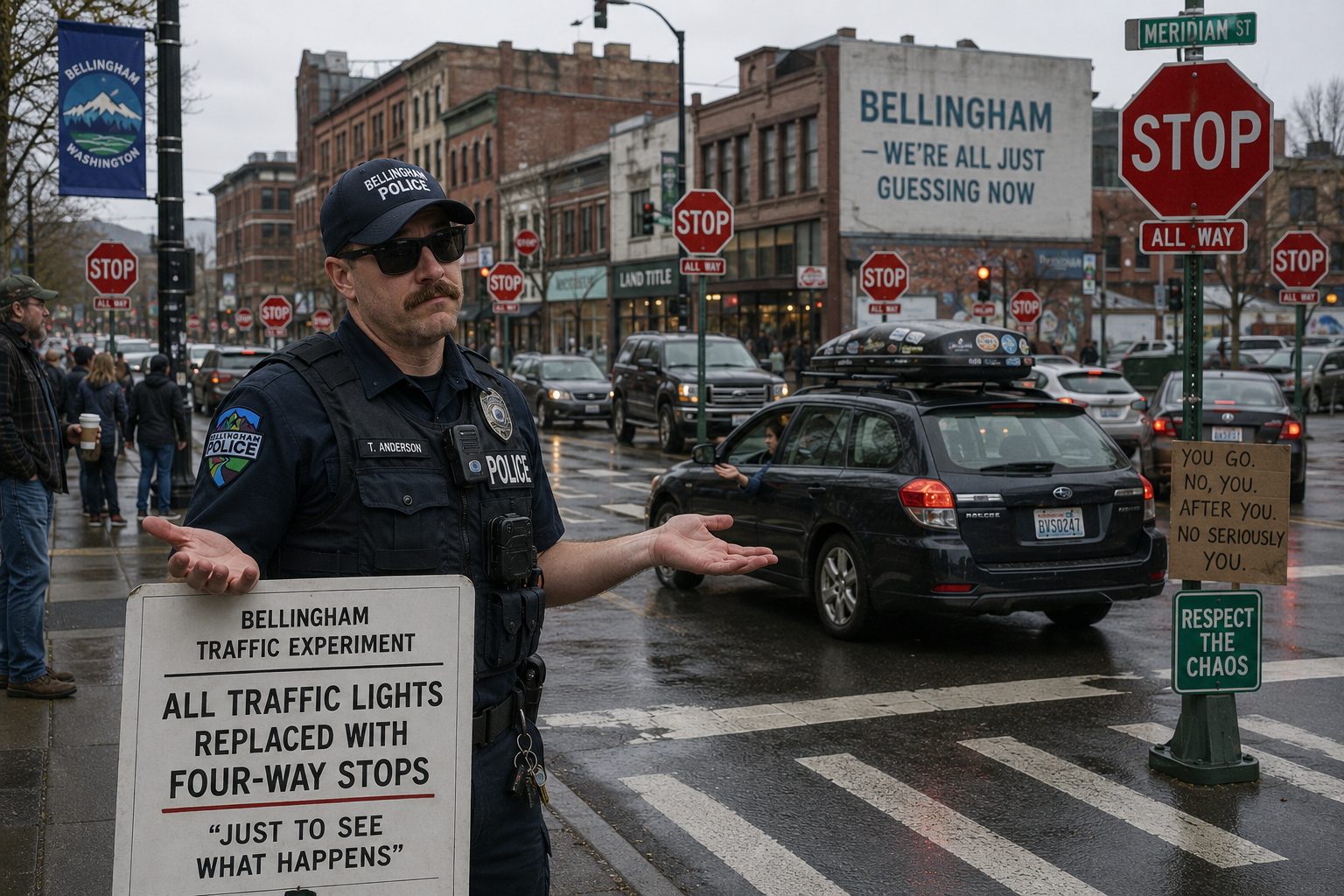

BELLINGHAM, Wash. — In what transportation experts are calling "either a revolutionary breakthrough or the funniest traffic experiment in American history," the Bellingham City Council voted Tuesday evening to replace every traffic light within city limits with four-way stop signs.
The pilot program, officially named the Community-Based Vehicular Equality Initiative, aims to "encourage eye contact, patience, and mutual confusion."
City officials insist the decision was backed by months of careful planning.
"We looked at traffic studies, engineering reports, public comments..." one council member explained. "Then we ignored all of them and asked ourselves, 'What if everyone just figured it out?'"
The first intersections scheduled for conversion include:
- Meridian & Bakerview
- Lakeway & Lincoln
- Sunset & Orleans
- Every intersection people already complain about on Facebook
Transportation engineers estimate the average commute could become anywhere from 12% faster to three business days longer, depending entirely on whether drivers remember who arrived first.
To prepare residents, the city plans to distribute a free educational pamphlet titled:
"No, You Go."
The guide covers advanced concepts such as:
- Making eye contact without creating an accidental standoff.
- Why waving everyone through at once doesn't actually help.
- Understanding that arriving second does, in fact, matter.
- Accepting that the lifted F-250 is probably going anyway.
Initial simulations reportedly ended after only seven minutes when sixteen Subarus politely insisted everyone else proceed first.
"It became less of a traffic model and more of a Canadian hostage negotiation," one engineer admitted.
Meanwhile, Bellingham police confirmed they have already begun stocking extra notepads in anticipation of thousands of conversations beginning with:
"Well... I thought it was my turn."
Local residents expressed mixed reactions.
"I'm cautiously optimistic," said one South Hill commuter. "Mostly because traffic can't possibly get any worse."
Within seconds, someone standing nearby laughed so hard they had to sit down.
Western Washington University researchers have volunteered to study the project, believing it may provide groundbreaking insight into human behavior under moderate inconvenience.
The study's working hypothesis is simple:
"Nobody actually knows how four-way stops work."
As construction crews began removing the city's first traffic signal, dozens of onlookers applauded before immediately arguing over who should leave the parking lot first.
At press time, the City Council had already announced Phase Two of the initiative, which would replace all lane markings with "good vibes and personal responsibility."
if with stoplights i leave an hour early to get to work now it will take 2 hours for me to gef fo work
Are you kidding me?